
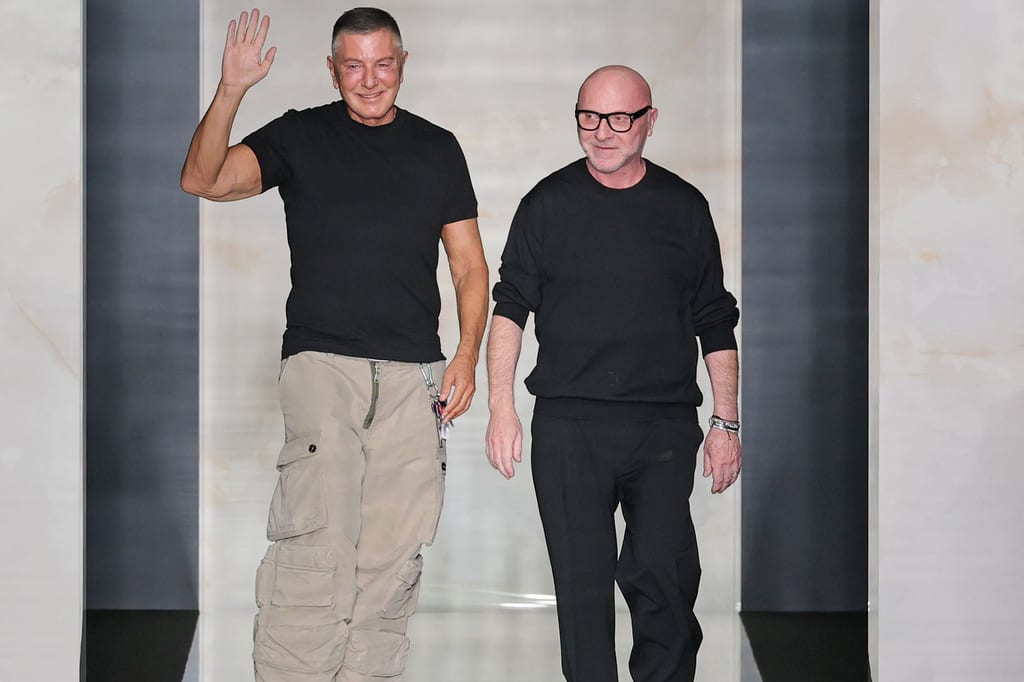
Stefano Gabbana has stepped down from Dolce & Gabbana. Well, kind of.
Gabbana, who co-founded the label with his then partner Domenico Dolce, has stepped back after four decades at the forefront of one of Italy’s most recognisable fashion houses. The news surfaced last night, although the decision itself was reportedly made back in December.
However, reports suggesting Gabbana is leaving Dolce & Gabbana entirely don’t reflect the full picture. While he has stepped down from several formal corporate and managerial roles, he remains deeply involved in the brand. This shift is less about departure and more about redefining his position.
Gabbana is shifting its focus away from operational responsibilities, such as business management and executive oversight, to refocus on the creative work that has shaped the label’s identity. To understand the significance of this change, it is helpful to examine the longstanding dynamic between Dolce & Gabbana.
Since founding the house in 1985, the pair have worked in close creative partnership. Domenico Dolce has often been associated with structure, tailoring, and strong Sicilian influences, while Gabbana has been linked to bold imagery and cultural references.
Even after their personal relationship ended in the early 2000s, their professional collaboration has continued. That balance has become a defining feature of Dolce & Gabbana’s identity.
With Gabbana stepping away from corporate duties, there is potential for his creative influence to become even more concentrated. Free from boardroom responsibilities, he can devote more time to the visual storytelling and high-impact design that have long defined the brand.
Over the years, Dolce & Gabbana has built a reputation on richly narrative collections. From Sicilian-inspired black lace and widow silhouettes to the grandeur of Alta Moda shows staged in historic Italian settings, the brand has consistently leaned into emotion, nostalgia, and spectacle. Religious iconography, baroque detailing, and references to Italian family life have all played a central role in shaping its aesthetic.
The company has emphasised that his role in shaping collections and maintaining that identity remains unchanged. In practice, this likely means his influence becomes more focused and less tied to business concerns.
As a privately owned company, Dolce & Gabbana continues to operate outside the structure of major luxury powerhouses. That independence has allowed the founders to maintain a strong personal vision, and Gabbana’s shift towards a purely creative role may reinforce this.
At the same time, the brand is navigating a more complex luxury market, with economic pressures and changing consumer behaviour affecting the industry as a whole. In that context, separating creative leadership from corporate management could also be a strategic move.
Ultimately, Gabbana is not stepping away from Dolce & Gabbana. Instead, he’s repositioning himself within it. By leaving behind corporate responsibilities, he is creating space to focus entirely on the creative direction that defined the brand in the first place. And if his past work is any indication, this shift could mark a renewed emphasis on the bold, expressive style that has long set Dolce & Gabbana apart.
More on Culted
See: If I could afford, one of these Cartier watches would come home with me