
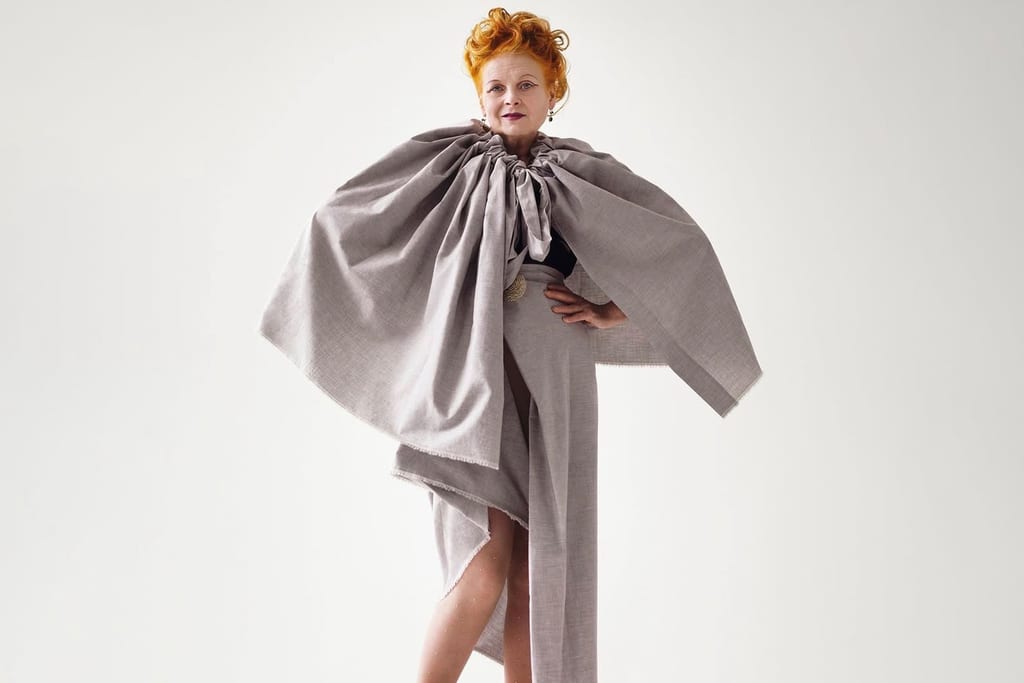
Vivienne Westwood was the kind of designer who changed the way people see themselves.
On what would have been her birthday, it feels impossible to talk about fashion without talking about her. In 1970s London, alongside Malcolm McLaren, Westwood established a visual identity for punk through their store at 430 King’s Road. First SEX, then Seditionaries. The ripped T-shirts, bondage trousers, and provocative graphics, including the now-infamous “God Save the Queen” imagery, created a movement.
Her 1981 Pirate collection is often credited with changing the direction of fashion entirely, shifting it far away from rigid, structured silhouettes into something more romantic, historical, and expressive. It marked the beginning of what would become a signature Westwood trait.
Then, in 1985, Westwood created Mini-Crini, where she fused the Victorian crinoline with the miniskirt. It collapsed centuries of fashion history into a single silhouette, creating something playful and subversive. But, perhaps one of her most culturally defining moments arrived in 1993 with the Anglomania collection. It was here that Westwood fully embraced British heritage, incorporating tweeds, tailoring, and aristocratic references to twist them into something irreverent.
That same year, Naomi Campbell famously fell on the runway in Westwood’s towering platform heels, a moment that has since become one of the most iconic images in fashion history. Even her corsets, reintroduced and reimagined throughout the late ‘80s and ‘90s, shifted the conversation. Once a symbol of restriction, Westwood transformed it into something empowering to reclaim the narrative around the female body.
Vivienne Westwood taught fashion how to think, and she made it political, too. Long before sustainability became paramount for brands, Westwood was vocal about climate change and overconsumption, using her platform to call out the industry she operated and thrived in.
On her birthday, what feels most powerful is her legacy as a disruptor. She was loud and deliberately didn’t fit into the status quo. Her influence still runs through fashion today, and you see it in designs that reject perfection in favour of personality.
Vivienne Westwood created a world where people could belong, without ever having to change who they are.
More on Culted
See: Slawn is changing the game, one beautiful piece at a time