
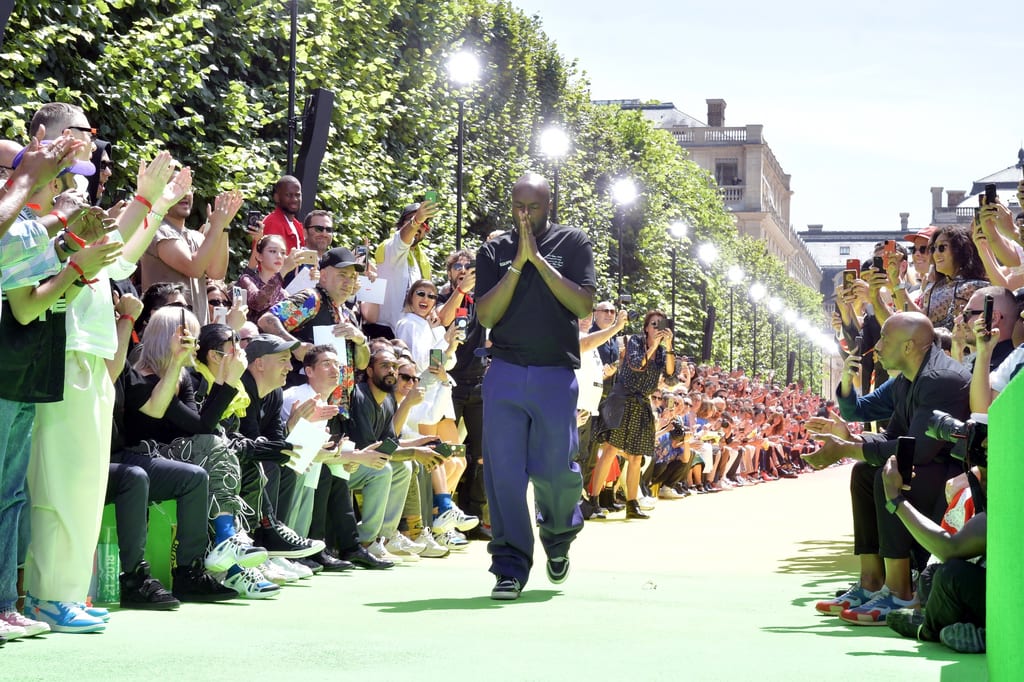
When Virgil was appointed Artistic Director of Louis Vuitton, a wave of euphoria came over the fashion set— namely those who don’t ascribe to its archaically white, male disposition. As Virgil sobbed into Ye’s arms after his first Paris show, it felt like the dawn of a new era—a win for every marginalized creative tired of seeing the appointment of another white face in the industry’s most influential positions. After all, he was the first black Artistic Director at Louis Vuitton, and his appointment loosely coincided with Edward Eninful’s taking over as Editor-in-Chief of British Vogue (and subsequently cleaning house to prioritize diverse hires). It was also an era of increased diversity on the runway and on screen, as consumers demanded to be represented by the brands they were purchasing.
But 7 years later, that feels like a long-forgotten pipe dream. As of today, there’s only one female creative director at Kering, almost every creative director of a major fashion house is white, and a mere 27% of the creative industry’sworkforce comes from a working-class background. Meanwhile, as of 2024, only 9 per cent of executive roles in the British fashion industry are held by people of colour. It’s as if companies have listened to consumers' desire for inclusivity in public campaigns, but behind the scenes, where they can get away with it, they’re sticking to their biased ways.
Granted, Abloh’s own efforts towards diversity weren't perfect: in 2019, he posted a photo of Off-White’s design team, which was, to the internet’s dismay, overwhelmingly white. (Tbf, Abloh said the photo was only representative of his Milan team, and that his design team was ‘as diverse as the world is big.’) But even if he was perfect, changing the course of an industry’s centuries-long legacy of racism and unconscious bias shouldn’t fall on one man, and as this lack of diversity today proves, for Virgil, it was an impossible cross to bear.
So why, despite a positive response to Virgil’s appointment and impressive sales rates, didn’t the rest of the industry take note? Why did it revert back (or in a lot of cases stick to) its long-ingrained biases? As the nepo baby discourse has mercifully highlighted, industries like fashion and entertainment are all about who you know, not what you know. A lot ofbig jobs in fashion aren’t exactly posted on LinkedIn, and if they are, people in the hiring manager’s purview will often take priority. This means that the hiring circle is much smaller than we might be led to believe, with only people already‘in the know’ hearing about— and being able to apply— for vacant positions.
Just look at Pharell: although it’s comforting to see a Black man continue Abloh’s legacy, should an artistic director have to be a cross-industry, multi-disciplinary sensation just to be considered? It often feels like the bar is higher for women and POC: the ‘work twice as hard for half as much’ rhetoric in disturbing action. As noted by 1Granary, “the industry is rife with examples of influential and successful creative directors who aren’t male or white. However, they all built their success independently before obtaining industry recognition. Just think of Rei Kawakubo, Vivienne Westwood, or Virgil Abloh ‒ all of whom achieved legendary creative director status by creating their own context for it.”
It also doesn’t help that fashion is so subjective: a woman might be turned down for a role for opaque, impossible-to-question reasons, for instance, that her vision ‘isn’t quite right,’ when really it’s because she has a two-year-old at home. A hiring manager may well think he’s making that decision based on energy and a desire to see the brand succeed, but it could just as easily be down to his biases. Yes, those biases might be unconscious, but the results are the same: ateliers and boardrooms from New York to Paris populated with white (often middle-class faces).
We’d also be remiss not to note that in some ways, fashion is merely a microcosm of society. It isn’t exactly a career you work in while doing your school exams to help your parents cover the bills. It’s also unreliable and inaccessible, meaning lower-income families might be reluctant to encourage their children to work in it. Grants are few and far between, and a lot of internships in the field (one of the only paths to get into the industry) are unpaid, making them impossible for people who need to earn a living to live.
So, what can be done? Teachers and other educators can be encouraged to let children know that fashion is an art form for everyone (no matter how white The Devil Wears Prada cast was), while governments can up their funding of art schemes for kids from marginalised and disadvantaged backgrounds, rather than cutting it to fund war. But realistically, hiring working-class, women, and POCs is the only path to diversity: whether that requires executives unlearning their biases or (properly) embracing diversity and inclusion schemes (a solution which is looking devastatingly unlikely given Trump’sstance). Tbh, it also feels like clearing house entirely at some of these companies wouldn't hurt.
Featured image via Getty
More on Culted
See: The culture wants Martine Rose at Balenciaga
See: Adobe Express tapped in with the youth for the A-List Festival