
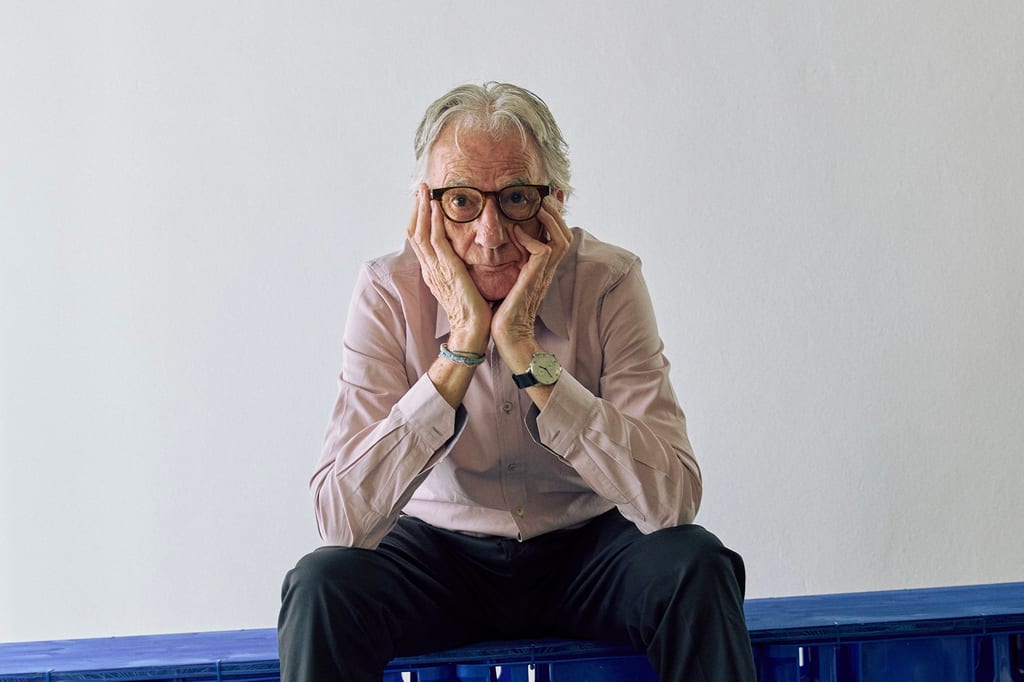
Sir Paul Smith opened up his first shop in Nottingham, in October 1970, a boutique where he sold clothes (back then it was other people’s designs), magazines, records. Today, almost 55 years later, Paul Smith stands unmatched, with 130 shops around the world and a distinctive aesthetic of “classic with a twist” casual pieces.
The day before his SS26 show (his first ever show at Milan Fashion Week), we got to sit down with the man himself to chat about his life and inspirations.
Can you talk to us about your journey to this moment?
“This year is, believe it or not, 55 years since my first little tiny shop. It's been a long journey, but a beautiful journey. And Paul Smith is quite unique in the fact it's still an independent company, owned by me. We started many years ago, but the growth has been very gradual. And that's probably one of the reasons why it's still here, because we never wanted it to go like a rocket. We always wanted it to grow very organically. We started with a small shop in my hometown of Nottingham, UK, and now, we work in 65 countries around the world.”
What has always inspired you in your work?
“I think the inspiration for me has always been through observation. Of course, you need to know what the other brands are doing so that you know what not to do. Because you need the awareness of what's happening, what the trends are. But my inspiration always comes from books, movies, holidays, observation. My father was an amateur photographer, so at the age of 11 he bought my first camera. Now, of course, we do this with a phone and we don't really, we can take 20 pictures and we delete 19. But then it was film – you had to be careful how you set up the shot, how you observed the shot. I think that's helped me a lot in my world of creativity.
“The biggest motivation for me, well first of all I've been with the same partner since I was 21 years of age, so she's called Pauline, I'm called Paul, so it's obviously a match made in heaven. We started the business together and we've never really desired great wealth. We've always enjoyed every day, we've always enjoyed building the business very carefully and slowly – the inspiration is just every day really.”
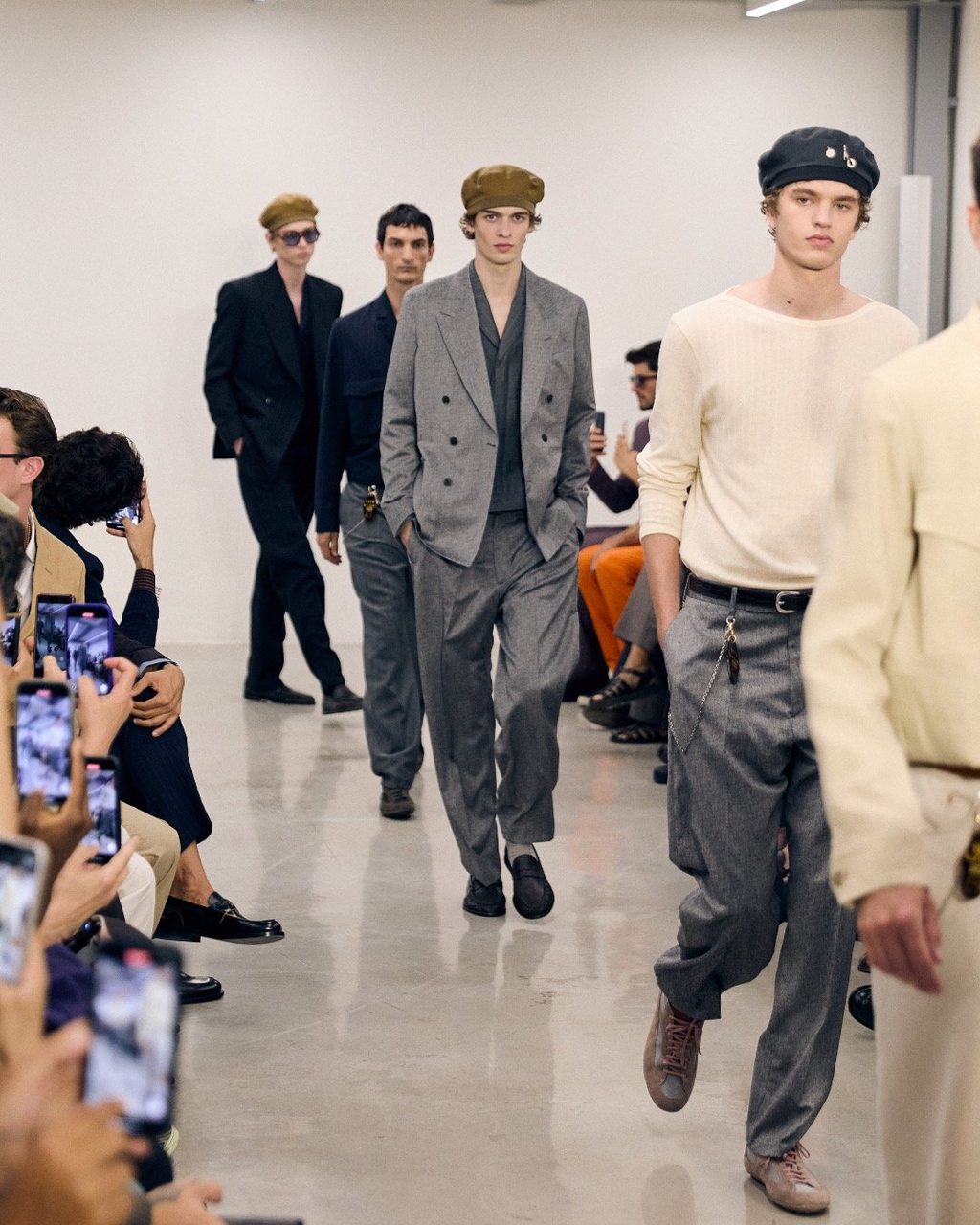
Can you talk to us about your SS26 collection?
“We're here in Milan in my showroom and tomorrow we'll be showing our SS26 collection for men. It's our first time showing in Milan. We've always shown in Paris, we’ve also shown in Florence and Japan, but never in Milan. We’re doing what we call a salon show: it's not a big audience, it's not a big catwalk, it's much more personal.
“My collection is inspired by my many years of travel. I found a book recently, a very old book, a souvenir book of Cairo and Egypt and I looked inside the book and the colors I think originally it must have been a black and white photography and it's been hand-coloured – the colours were really fantastic – and so I used that as a starting off point which then meant that there was some very vivid colors in the collection but also some very very stable colours, dark brown, of course black, navy blue.
“The next part of the inspiration was really markets, street markets, because I've always loved street markets: they're full of trinkets and small things you can find and strange patterns and textures. There’ll be like little chains around the neck, or a little piece of tape fabric around the wrist, or there'll be a hat with little charms on it, or all things that you might possibly find in the street market and that you might add to your outfit.”
Why Milan?
“We sell to many shops across the whole of Italy, and I have a home here, in the Tuscan area, a few hours from [Milan]. I've been coming here for over 30 years, so I have a strong affection for the Italian way of life, the food, the spirit. Italians, they work to live rather than live to work, so that's pretty good. And so I thought, Milan, yeah, why don't we give it a try after 100 shows in Paris?”
You have a lot of military-inspired designs, what draws you to this sort of uniform dressing?
“I think the point about uniforms is that they are created for a purpose. Uniforms have a power about making you look important, making you look qualified. Army and Navy, Air Force uniforms are about aggression. Ceremonial uniforms are about elegance and authority.
“But, I don't really go to uniforms for that. I go to them because they have lots of very practical pockets and practical aspects to them, so the big pockets that are on many trousers that most young people still wear, they originally were created for equipment or maps, they all had reason to be there.”
How has your background in tailoring influenced your work?
“You can compare it to being an architect. An architect will have a grand idea about a building, but they need to understand about engineering or whether the crazy idea is going to stand up, then you need the background in order to be playful.
“The fact that I know how to make a suit and how to cut a suit, how to construct a suit, means that you can deconstruct a suit and you can play with it in different ways. I'd always recommend understanding the basics.”
How do you feel the fashion industry has evolved, and what would you advise young creatives starting out now?
“Well I think the point about being a young creative now is, first of all, it's very very very competitive because most art schools, fashion colleges, universities now, 40 years ago probably would have had 30 fashion students in a course. Now, they have like 2,000 students. The competition is enormous.
“You have to have a point of view. You've got to think why should anybody employ me? What's my point? You need to have a good knowledge about why somebody would employ you. Now, it's not good enough just to be a designer. You have to be able to understand about social media, communication and in the future AI. It's a lot more complicated than it used to be. But, you know, definitely have a go, but it's not going to be easy.”
Anything else that you’d like to add?
“The main thing is, you know, every day is a new beginning. If you're having a day which is not so great today, then wake up the next morning and just go for it. Because there's always an opportunity out there, but you've got to be alive. You've got to think left and right of the obvious. If you go down the obvious route, you won't progress. If you go left and right of the obvious, you might have a chance. That's my advice. See you. Bye. Thank you.”
Watch our interview with Paul Smith on YouTube
Featured images Culted©
More on Culted
See: Michael Rider’s new era is exactly what we’ve been wanting at CELINE
See: Why is the jewellery industry booming despite the luxury slowdown?