
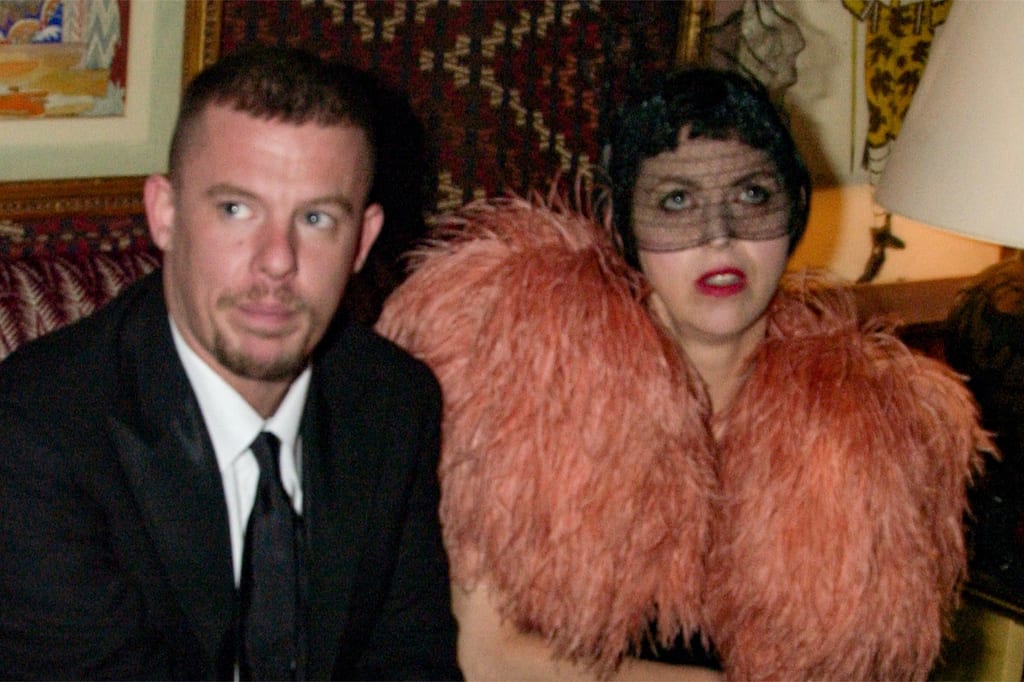
Few rival Isabella Blow’s impact on the fashion industry. The British fashion editor and all-round creative force had an almost preternatural ability to spot emerging talent and for revamping the old and dated: under the wave of Blow’s magic wand, the tired was made fresh. Video essayist @understitch has just released a book about Blow’s life, titled “The Life and Death of Isabella Blow: The Woman Who Discovered Alexander McQueen,” an expansion of her video essay on Blow’s legacy.
The eldest daughter of Evelyn Delves Broughton, Blow was born into the British aristocracy in 1958. She grew up in Hilles House, a stately home in Gloucestershire, but despite her idyllic surroundings, had a tumultuous upbringing. She almost lost touch with her mother following her parent's divorce, and her father squandered the family fortune, leaving the family to vacate Hilles House and move into a modest cottage on the grounds. Perhaps most notably in the shaping of Blow, her younger brother passed away under her watch as a child, a tragic accident that had a lasting impact on her mental health.
But Blow was a creative force. In 1979, she falsified her A-level results to get into Columbia University in New York. While in New York she became Anna Wintour’s assistant, when her propensity for recognizing artistic genius was noticed. Blow would go on to discover Stella Tenant, Sophie Dahl, and Philip Tracy, but it was her relationship with the late Lee Alexander McQueen that shaped her career and public persona. Blow happened upon McQueen at his MA design showcase in 1992, and after harassing his mum with phone calls, became his mentor and confidant, an unofficial incubator of his talent, pouring money into him. Blow also had a seminal impact in the publishing world, turning around then-staid magazines like British and American Vogue, The Sunday Times Style, and Tatler, thanks to her avant-garde ideas and famously ambitious budgets (which at times spelt disaster).
Blow is as renowned for her eccentricity as she is for her talent. She was rarely photographed without one of Tracey’s creations on her head, and was quoted saying, “if you're beautiful you don't need clothes. If you're ugly like me, you're like a house with no foundations; you need something to build you up.” In New York, Blow was welcomed into the circle of Jean Michael Basquiat and Andy Warhol, and became infamous on the nightlife scene for her signature party trick: strip teases.
But Blow’s idiosyncrasy wasn’t just the result of creative energy—her extreme highs and nadirs were down to the debilitating emotional tumult that would eventually kill her. When it came to her mental health, fashion was both a refuge and a catalyst: she was at her best when she was creating, but her lows were brought on by multiple firings, the end of creative relationships, and the infamously inconsistent nature of work in the fashion industry.
Blow died by suicide at age 48 in May 2007, but her legacy shaped fashion forever.
Image via Getty
More on Culted
See: Is your Gorpcore killing you?
See: Breaking down the political messages behind Kendrick Lamar’s Super Bowl Half Time show
How Gaelic Athletic Association gear became the ultimate drip