
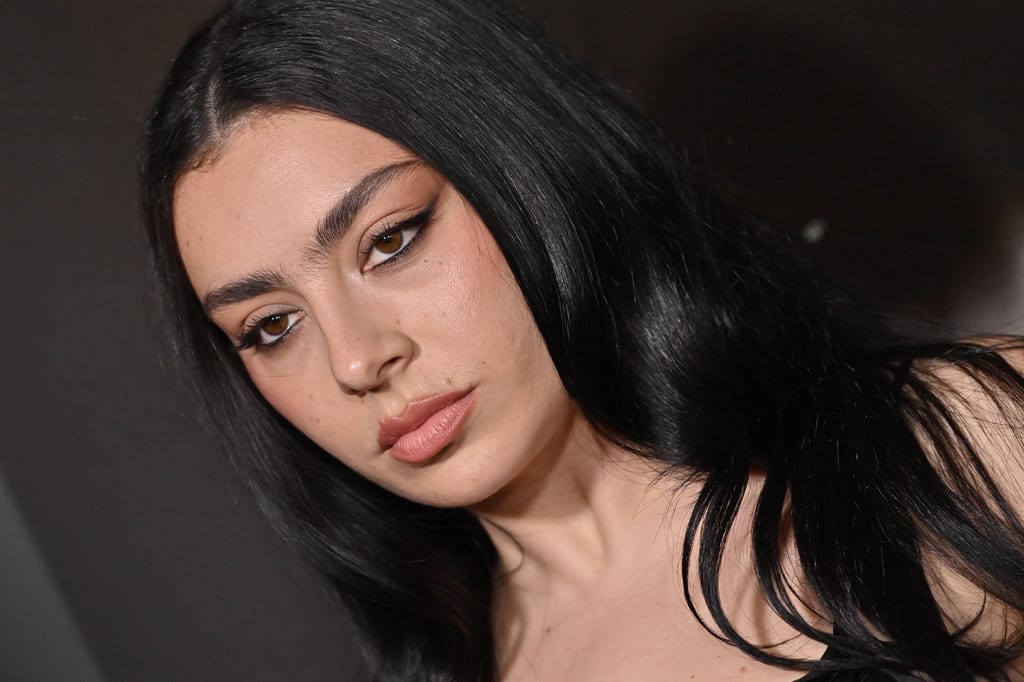
A lot of fuss has been made over the past few years about nepo babies: their fame and monetary privilege; how much of their success is down to their bloodline; how much talent they have and whether or not they’ve put the work in to nurture it. But there’s another wave of talent—or lack thereof, depending on whom you ask—sweeping film and television, the famous (by means other than acting) celebrity. And it’s not general film and television that they’re cropping up in — it’s horror: Over the past few years Kim Kardashian appeared in American Horror Story, Method Man in The Vampire Vs. The Bronx, Travis Kelce in Grotesquerie, and it’s recently been announced that Charli XCX will star in upcoming movie Faces of Death, a remake of the 1978 gruesome cult favourite of the same title.
To be a celebrity today is to be a multi-hyphenate: not satisfied with excelling in one lane, or perhaps to ensure income longevity if that lane ever tapers off (after all, a lot of celebrity jobs have a younger-than-average retiring age) they work to diversify their portfolios, hopping from the microphone to the fragrance lab to the design studio.
Of course, celebrities have always appeared in movies and TV shows: it gives the audience a fun moment of recognition, and acts as a mutually beneficial publicity stunt for the studio and celebrity. It's impossible to forget Trump’s brief appearance in Home Alone, 90s sitcoms like Will&Grace and Frasier had guest stars by the gallon, while more recently Bella Hadid made a cameo in modern cowboy show Yellowstone.
Models and singers (Hadid included) have long argued that the transition from modelling to acting is a natural one, as both are inherently performative and involve catering to an audience or camera. And using horror as a segue makes sense: bar the recent influx of more elevated offerings, it’s long been considered lower-brow than traditional cinema—a hammed-up scare fest over an art form: the expectations of actors are lower and the roles generally don't require as much subtlety.
Writer and director Ryan Murphy clocked onto this, and is behind the biggest celebrity-horror castings over the past decade. He cast Lady Gaga and hopped on the Taylor Swift hype, casting Travis Kelce in Grotesquerie. His work also brings the celebrity to horror pipeline and nepo baby Venn diagram into sharp relief: he gave Kaia Gerber and Paris Jackson some of their first acting credits. And not all fans have supported the exhausted attempt at extra publicity: many have even accused American Horror Story of being a “revolving door of nepo babies.”
So is it fair for celebrities to switch lanes with little prior experience, especially in an industry in which millions of professionally trained, struggling actors are fighting over bit parts (not to mention health insurance)? A recent study revealed that 90% of actors out of work, while a mere 2% actually make a living from acting. So what do actors themselves make of the celeb-to-horror-pipeline? “If it’s a cameo of themselves in real life, that makes sense. But as for acting, I think it’s ridiculous. Only if they’ve actually done a casting and are amazing, then I’m all for it,” says Beatriz Couceiro, a Portuguese actor based in LA.
In an ideal world, after the celebrities' initial role, the industry would do its job: If the actors are good, they would go on to further work (think Lady Gaga, who, after AHS went on to star in A Star is Born, House of Gucci, and Joker: Folie à Deux.) The others would be weeded out. Paris Hilton, who, at the height of her fame was cast in the slasher film House of Wax, left the acting scene as quickly as she came onto it. But that's not always the case: Travis Kelce received less than glowing reviews in Grotesquerie but is slated to be appearing in a whole spate of movies, including Happy Gilmore 2.
Realistically, it’s biased and more than a little unfair to hire already famous celebrities without proper credentials, and probably flouts the vast majority of employment laws that exist in other industries. But with celebrity culture taking over and success being measured in numbers, it's understandable that film and television are using ready-made celebrities as pawns for a bigger audience, despite the risk they’re taking when it comes to the quality of the acting. “It’s all about money, money, money,” remarks Couceiro.
Featured image via Getty ©
More on Culted
See: Sandy Liang FW25 was a Polly Pocket dream
See: Breaking down the political messages behind Kendrick Lamar’s Super Bowl Half Time show