
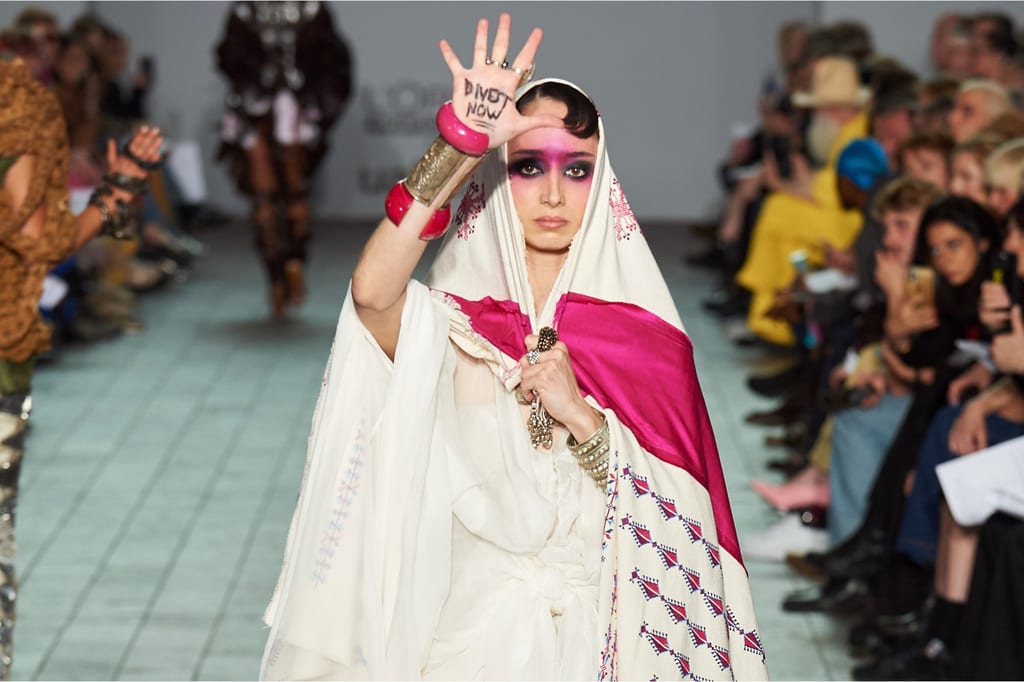
It takes a lot to get mainstream fashion publications—most of which prioritise remaining partisan on world affairs—to talk about international conflict. It takes even more to get them talking about Gaza. That’s exactly what Palestinian designer Ayham Hassan did when he sent a collection dedicated to the region down the Central Saint Martins graduate runway on 4th June, to mass coverage from i-D, Dazed, and Vogue.
Hassan hails from Ramallah in the West Bank, Israeli-occupied Palestinian territory. It was there that part of his collection was made, with dressmaker friends of his family coming together to construct a garment that was shipped 3,461.34 miles to London for the show. The majority of the collection, which is titled “IM-Mortal Magenta: the Colour that Doesn’t Exist,” however, was created by Hassan himself, using fabrics and techniques that were developed in, or are emblematic of, his home.
The show’s title references magenta, because, Hassan explains, it’s one of the key motifs of the thawb worn in Gaza. He also employed a weaving technique called Majdalawi—named after the city of Majdal in Gaza, that was being kept alive by a Palestinian family who have since been displaced to Egypt. “The war doesn't only kill humans, it also destroys stories and memories and culture and hundreds of years of creativity and talent and authenticity,” he tells me.
Rich in extravagant headdresses and Arabic patterning , even to an untrained eye, it was clear that the collection was firmly rooted in the Middle East's design codes. In addition to knitted wool and woven cotton from Palestine, the garments were constructed out everything from dead stock materials to silk organza, to unconventional textiles like rubber bands and pleated paper.
The collection was an ode to Palestine’s cultural richness: a reminder of the resilience and creativity of a community that has, of late, been discussed almost exclusively in connection to tragedy. “The whole thing is a reflection on what's going on. It's a reflection and celebration of these crafts and beautiful embroidery techniques that are just beyond haute couture…The collection is discussing a lot of symbols, a lot of pivotal moments in Palestinian history resistance, and it's my kind of resistance, it’s my kind of documentation and cultural preservation,” Hassan says.
But despite the show going swimmingly and the collection being well received, to Hassan, the whole thing feels bittersweet, given the fashion industry’s complicity in the conflict. It's for this reason that Hassan's models emerged down the runway with the words “boycott L’Oreal” (Hassan believes the cosmetics company has been complicit in the violence) strewn across their hands — a protest stunt that was strictly their idea, but which Hassan welcomed.
Hassan is also cognisant of the dissonance between the glamour and excess of the fashion industry and the suffering taking place across the globe — particularly given that we’re served up imagery of both in the same breath. I ask him why, in his mind, fashion retains its importance. “Because people like me exist in it,” he answers candidly. “Fashion is about expression and body and movement and textures and history and ethnicity,” he says. “When I scroll on my feed, I see this horrific scene in Gaza, and then I see a fashion collection from Galliano in the 1920s. I thought the best way for me to approach this is learning more about Gaza and learning more about the history and heritage.”
It’s this ethos that he plans to work into his collections well into the future. “My ultimate goal is to have my own brand, to work for a brand, to learn from the industry and create and just have the space and the funds to create what I want and comment on things that I want to comment on.” A designer through and through, he's also determined to ensure that his clothes are not only a form of commentary—but garments that people are eager to wear. “I would love to find the balance between discussing and being provocative about everything and utilizing that into clothes that people want to wear," he says. “My work is too powerful to be ignored”.
More on Culted
See: Makeup artist Aoife Cullen is doing it for the female gaze