
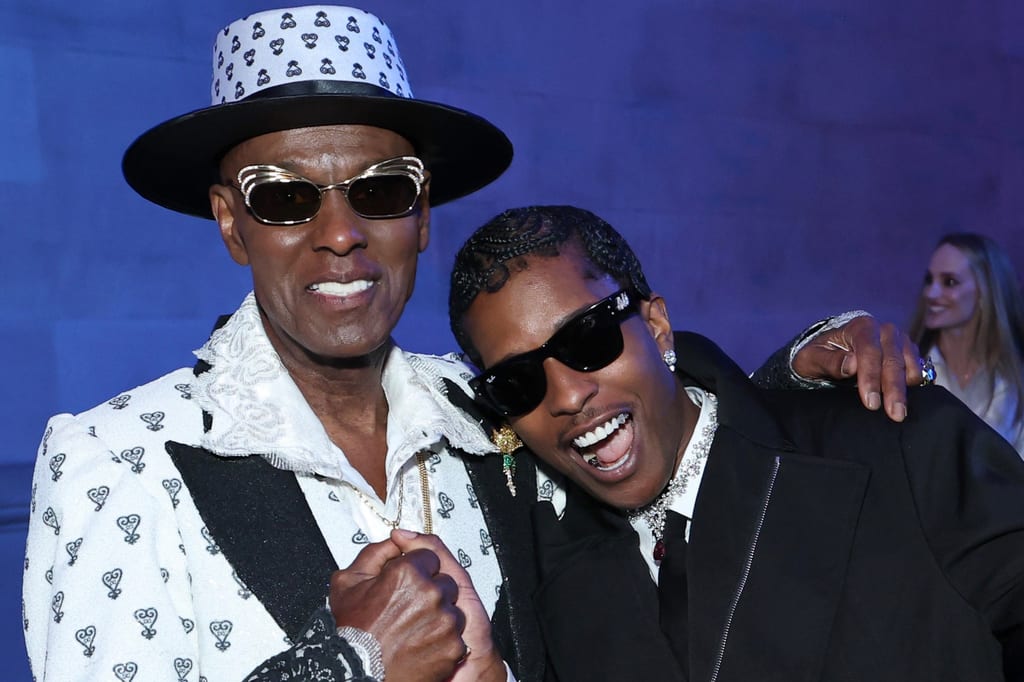
You might attribute logomania to the big designers: it’s their iconography, after all, that’s strewn across bags and clothes the world over. But it was a guy from Harlem, New York, back in the 1980s, who paved the way for the logomania we know today.
Daniel R. Day—known by his moniker as Dapper Dan— got into fashion in Liberia in 1968 when a tailor constructed a Western-style suit for him out of African textiles. It was this, according to The Guardian, that served “as the primordial soup for his “Africanisation” of the designs of high-end European fashion houses.”
When Dan returned to Harlem, he started selling stolen designer goods out of the boot of his car. Then, in 1982, he took the plunge and set up a fur shop on 125th Street. But although he now operated a brick-and-mortar business, his approach was unconventional: the store was open 24/7 to accommodate the irregular hours of dealers, gangsters, boxers, and rappers.
Eventually, Dan began to notice the attention that obviously-branded goods garnered in his customers. An academic through and through (Dan wrote essays on Pan-Africanism for the Harlem publication Forty Acres and a Mule.), he began looking into the history of brand logos and studied leather printing techniques to create his textiles emblazoned with the iconography associated with the biggest houses at the time: Louis Vuitton, Gucci, and MCM.
But Dan wasn’t just gonna become a bootlegger, designing replicas of what already existed. He designed logo-heavy garments that—unlike the white-operated luxury brands—actually incorporated Black style. His clothes were also custom-made to meet the needs of his clients: some of the parkas were bullet-proof, while jackets featured extra-deep pockets to conceal weapons.
Tbf, given how elitist the industry was at the time, it would’ve been near impossible for an ex-con from Harlem to come up with a brand, copyright it, and make it one of the biggest in the world. So Dan re-appropriated what already existed. Aptly, he referred to his garments as “knock-ups” as opposed to “knock-offs,” saying he “blackenised” the brands.
But the legacy fashion set wasn’t as enamored with Dan as Harlem’s underbelly. In 1992, Fendi sued Day on the grounds that his use of their logo was trademark infringement, and he was forced to close his store.
But Dan persevered. And so did logomania. Not only did his work have a seminal impact on street style, it also made its mark on high fashion. In 2017, Gucci sent a bomber jacket strewn in the Gucci monogram down the runway— a jacket that bared a striking resemblance to one Dan made for Diane Dixon back in the day. Social media users were quick to call out the house, and to their credit, they acted fast: hiring Day to design a capsule, and funding a new store for him. Then, in 2020, Gucci released items intentionally designed to resemble fakes, while British designer Martine Rose often playfully re-invents her own logo.
And Dan’s influence can still be felt: in 2020, Gucci released items intentionally designed to resemble fakes. Indeed, our contemporary approach to logos as playful and semi-ironic has roots in Dan’s reclamation of what was then an elitist and exclusionary status symbol.
Featured image via Getty©
More on Culted
See: France has passed a new law that regulates fast fashion
See: We spoke to CSM graduate Seoyoun Shin about her collection